Overview
A Risso's dolphin is born dark. Grey, sometimes olive-brown, with smooth unmarked skin. It will spend the rest of its life turning white — not by changing colour, but by accumulating scars that never fade. Every rake mark from the teeth of another Risso's, every gouge from the beak and tentacles of a squid it has hunted in deep water, every circular bite from a cookie-cutter shark stays pale and stays visible.
By old age the animal may appear almost entirely white. It has not transformed. It has become legible. An old Risso's dolphin wears the complete visible record of everything it has fought, hunted, mated with and survived — and researchers read those markings to identify individuals, because no two histories are the same.
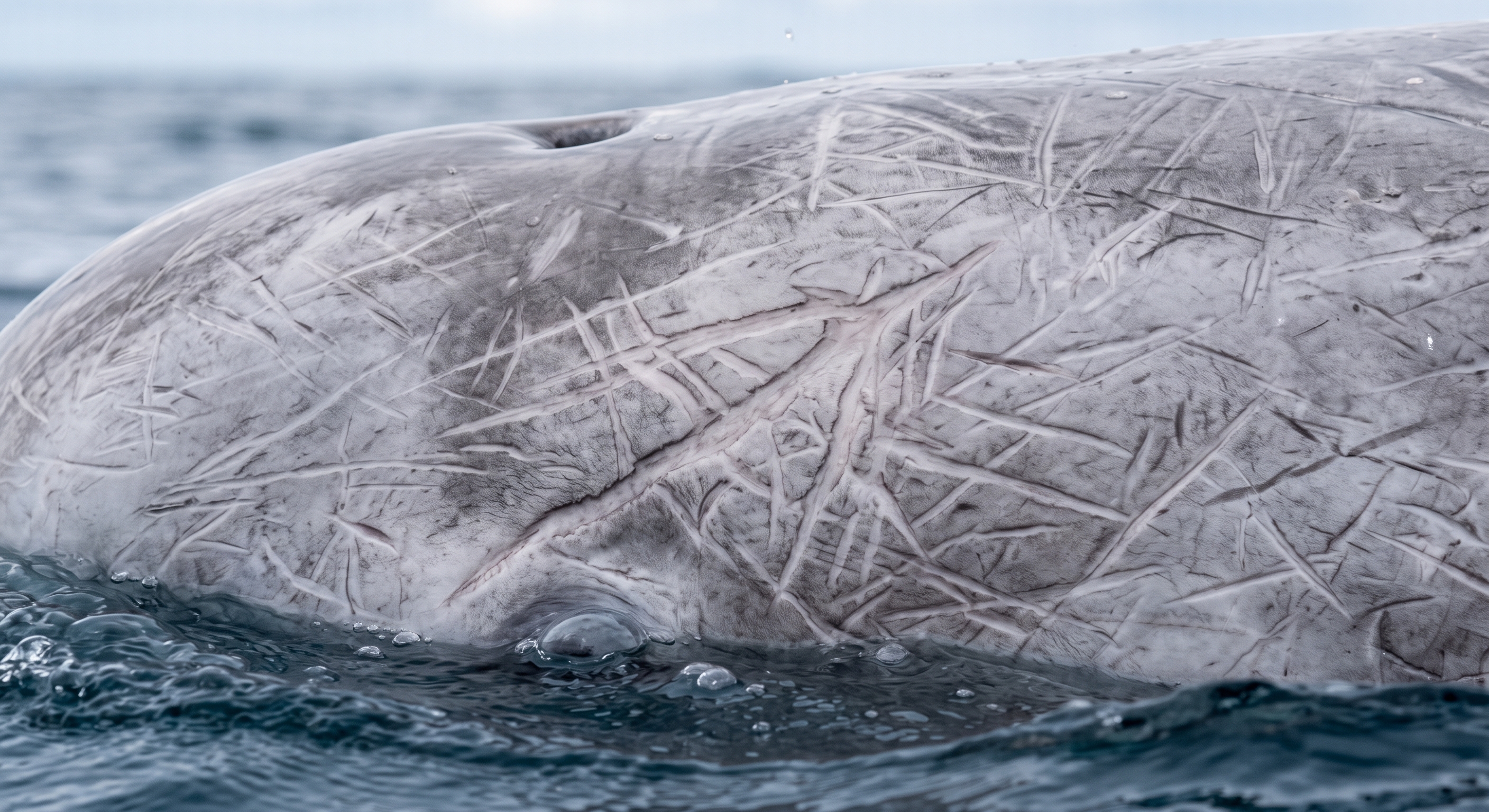
An adult Risso's dolphin surfacing, its pale body covered in the criss-crossed white scars accumulated over a lifetime
A Body That Keeps the Record
The Latin name griseus means grey, and refers to the mottled grey-and-white appearance of adults. The scarring comes from two main sources, and both are ordinary parts of a Risso's life rather than misfortunes.
Its own kind. Risso's dolphins rake each other with their teeth during social interaction — establishing relationships, competing, playing. These are not injuries in any dramatic sense. They are the physical residue of a social life, and a heavily raked animal is a heavily social one.
Its prey. Risso's are squid specialists, and squid do not surrender quietly. Beaks and tentacles leave marks. An animal that has eaten well for thirty years shows it.
Almost no teeth
Curiously, for an animal so marked by teeth, the Risso's has very few of its own — typically two to seven pairs of blunt, peg-like teeth in the front of the lower jaw only, with usually none at all in the upper. This is among the lowest tooth counts of any cetacean. The teeth are for gripping soft-bodied prey, not for cutting, and their arrangement is one of the features that distinguishes the genus.
The head itself is unmistakable: bulbous, entirely without a beak, and split by a distinct vertical crease running down the centre of the forehead — a feature no other dolphin has. The dorsal fin is tall and sickle-shaped, dark, and unlike the body it rarely scars, so that from a distance an old Risso's can look like a white animal carrying a black sail.
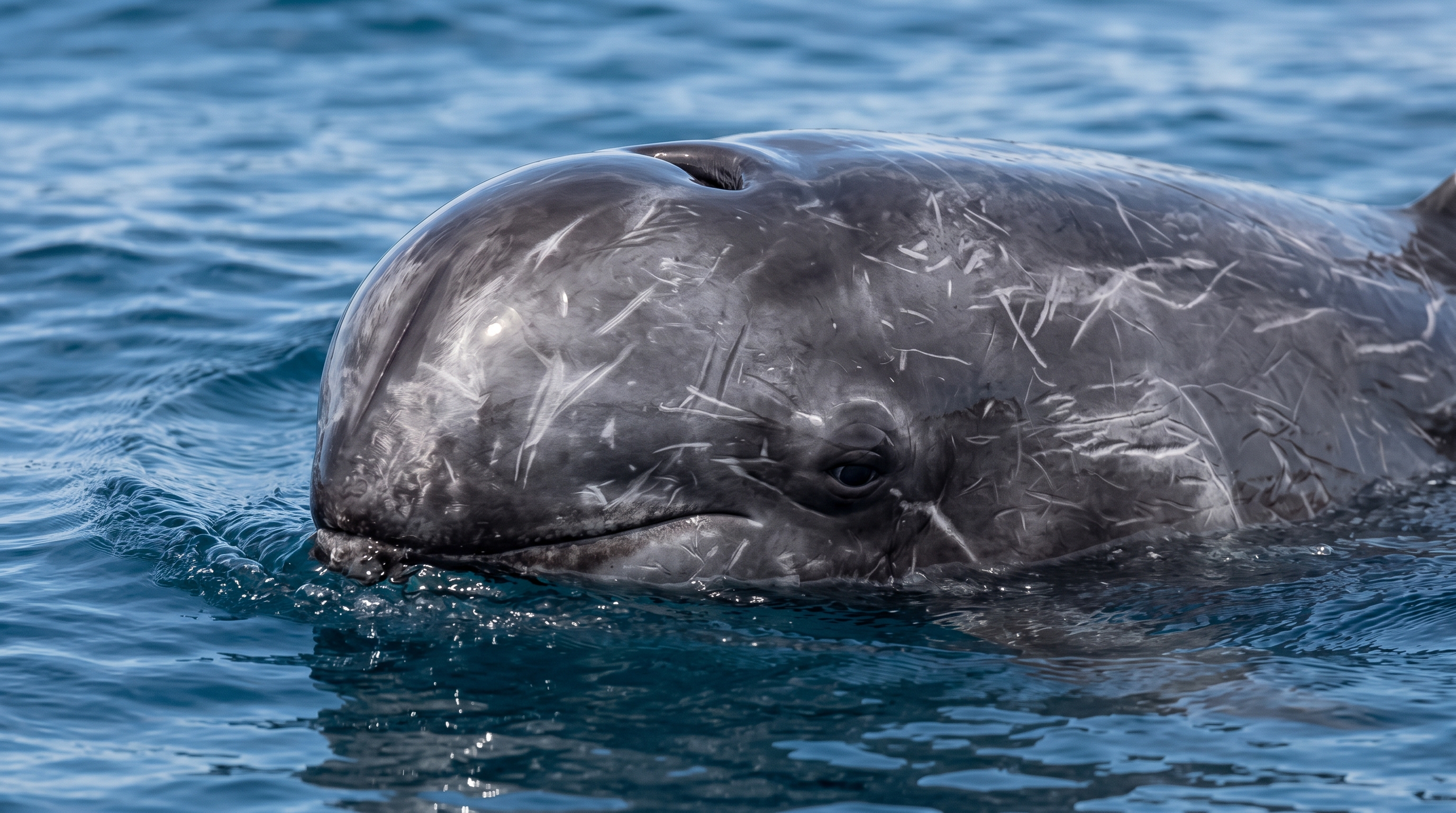
Close view of a Risso's dolphin's blunt beakless head showing the distinctive vertical crease down the centre of the forehead
The Spin Dive
Risso's dolphins hunt in deep water, mostly at night, along steep underwater drop-offs and submarine canyons where squid concentrate. They regularly descend beyond three hundred metres and have been recorded past six hundred, with dives that can exceed thirty minutes.
Getting down there efficiently is the problem. A 2021 study tracking tagged animals in the Azores documented a behaviour not previously described in any cetacean, which the researchers named the spin dive. The dolphin exhales to reduce buoyancy, then begins an intense burst of stroking combined with a rapid right-sided lateral rotation, corkscrewing almost vertically downward. The manoeuvre cuts descent time sharply, which means more of a finite breath is spent hunting rather than travelling.
The same study found that Risso's appear to decide before they leave the surface whether a dive will be shallow or deep, and adjust their approach accordingly — evidence of planning rather than reaction.
Hunting in the dark
At those depths there is no light. Risso's locate squid entirely by echolocation, producing clicks and burst-pulse sounds adapted for detecting soft-bodied prey against the deep scattering layer. They surface with a small, inconspicuous blow, and between dives will often log at the surface — resting motionless — before descending again.

A small pod of Risso's dolphins at the surface at dusk, ranging from a dark young animal to a nearly white adult
Company and Distribution
Risso's dolphins are found worldwide in temperate, subtropical and tropical waters, from roughly 64° North to 46° South. They favour deep offshore water, particularly the edges of continental shelves and the mouths of submarine canyons — anywhere the seabed falls away steeply and squid gather.
Typical pods number between ten and thirty animals, though they have been recorded alone, in pairs, and in loose aggregations of many hundreds. They associate readily with other species, including bottlenose dolphins, Pacific white-sided dolphins, northern right whale dolphins and gray whales. Despite a reputation for being boat-shy, they breach, spyhop, and slap their flukes and flippers against the surface with considerable energy.
They live around thirty to forty years — a fraction of the bowhead's span, which makes the completeness of their visible record all the more striking. A Risso's does not have two centuries in which to accumulate its markings. It writes its whole history in a few decades.
Status and Threats
Globally the Risso's dolphin is assessed as Least Concern, and it is not listed as endangered or threatened in United States waters. It is genuinely widespread, and there is no evidence of a global decline.
That does not mean it is untouched. Risso's are taken in drive hunts and directed fisheries in several regions, and they are caught incidentally in gillnets, driftnets and trawls. Because they hunt at depth, they are exposed to the effects of intense underwater noise — necropsies of stranded animals in the Canary Islands have documented acute decompression sickness, a condition that in other deep-diving cetaceans has been associated with acoustic disturbance.
Squid populations are also shifting with ocean temperature, and a specialist predator follows its prey or goes without. Because Risso's occupy deep-water habitat that is poorly surveyed, changes in their numbers would likely be noticed late. Conservation groups treat them as an indicator species for the health of deep offshore ecosystems — animals whose condition reports on a part of the ocean that is otherwise difficult to observe.
Image Note: Images on this page are artistic interpretations created with AI tools to convey ecological and behavioural context rather than anatomical precision. See our Image Methodology for details.
References
- NOAA Fisheries. Risso's Dolphin. https://www.fisheries.noaa.gov/species/rissos-dolphin
- Visser, F. et al. (2021). Risso's dolphins perform spin dives to target deep-dwelling prey. Royal Society Open Science. https://www.ncbi.nlm.nih.gov/pmc/articles/PMC8633802/
- Whale and Dolphin Conservation. Risso's Dolphin. https://us.whales.org/whales-dolphins/species-guide/rissos-dolphin/
- Marine Conservation Society. Risso's Dolphin. https://www.mcsuk.org/ocean-learning/wildlife-a-z/rissos-dolphin/
- ORCA. Risso's Dolphin Species Guide. https://orca.org.uk/species-sightings/dolphins/rissos-dolphin
- Monterey Bay Aquarium. Risso's Dolphin. https://www.montereybayaquarium.org/animals-the-ocean/animals-a-to-z/rissos-dolphin
- Fernández, A. et al. (2017). Deadly acute Decompression Sickness in Risso's dolphins. Scientific Reports. https://www.ncbi.nlm.nih.gov/pmc/articles/PMC5648807/